 English
 Indian
 العربية
 Español
 Deutsch
 Türkçe
 Русский
 Français (Afrique)

Ähnlich wie bei Baldur's Gate III bleiben die Begleiter in Exodus nicht bei dir, wenn du Entscheidungen triffst, mit denen sie nicht einverstanden sind
Wir sind sicher, dass jeder, von den Entwicklern bis zu ihr, der diesen Artikel liest, es leid ist zu hören, wie Exodus an Mass Effect erinnert. Ein Sci-Fi-Rollenspiel mit romantischen Begleitern und starkem Fokus auf wahlbasierte Erzählung wird diese Vergleiche hervorrufen, aber Exodus will nicht nur ein Liebesbrief an BioWares Space Opera sein. Es wird seinen eigenen Weg gehen, Systeme weiter vorantreiben, und ein Weg dazu ist durch sein Affinitätssystem.
Ja, du wirst in diesem System romancierbare Charaktere haben und deine Beziehung zu Begleitern durch Dialogoptionen und wichtige Entscheidungen verbessern. Aber wie Narrative Director Drew Karpyshyn Gamereactor auf der Gamescom sagt, sind die Mechaniken viel tiefgründiger. "Wir versuchen, dir diese Möglichkeiten zu geben, bei denen du zwar Zustimmung bekommst, aber auch Ablehnung bekommst, und oft bringen wir dich in Konflikte, bei denen deine Begleiter jeweils ihre eigenen Wünsche, Bedürfnisse und ihren eigenen Handlungsbogen haben, der nicht immer zu dem passt, was du tun möchtest", erklärte er.
Das könnte bedeuten, dass du gerade dabei bist, eine Romanze mit einer Figur einzugehen (nicht mit dem Oktopus Salt, wie Karpyshyn klarstellt), nur um dann vor einer Entscheidung zu stehen, die dich zwingt, dich zwischen einer möglichen Romanze und dem Weg zu entscheiden, den du ganz offensichtlich einschlagen möchtest. Es sieht so aus, als würde es die Spieler davon abhalten, ihren Kuchen zu haben und ihn zu essen, es sei denn, sie sind so sehr einer Romanze verpflichtet, dass sie mit allem gehen, was ihr Partner will.
Letztlich läuft alles darauf hinaus, dass die Entscheidungen der Spieler wichtig sind. Im Affinitätssystem bedeutet das vielleicht auch, dass man die Jungs, die man nicht so sehr mag, nicht einfach ignoriert. "Vielleicht hat eine Figur eine etwas geringere Affinität, und man denkt sich dann: 'Ich muss ihr einen Gefallen tun. Ich muss ihr hier einen Erfolg bescheren.' Oder man macht sich Sorgen, was passieren wird, weil das hier Konsequenzen hat", erklärt Karpyshyn.
Das kann offenbar zu ziemlich extremen Umständen führen, wie Karpyshyn neckt, dass wir unsere Begleiter-Reihenfolge je nach Entscheidungen ändern können. "Wir sagen einfach, dass nicht jeder, der das Spiel startet, das Spiel unbedingt mit dir beendet. Und du bist vielleicht nicht im selben Team wie jemand anderes, der das Spiel spielt, abhängig von den Entscheidungen, die du triffst."
Das klingt sehr danach, wie die Entscheidungen, die dir in Baldur's Gate III Gefährten kosten können. Plündere das Dorf der Tiefling-Flüchtlinge, und Karlach und Wyll wollen nicht mehr bei dir bleiben. Hoffen wir, dass Exodus' Sichtweise nicht einfach einen klaren "böse gegen nicht-böse"-Weg hat.
Seht euch unten den Rest unseres Exodus-Interviews an und hier unsere praktische Vorschau von der Gamescom.
New DLSS 5 mod offloads Neural Rendering to a second card massively cutting the AI filter's performance hit
A developer has vibe-coded a new ReShade add-on file that offloads the DLSS Neural Rendering workloads to a second GPU, almost negating the otherwise massive DLSS NR performance hit. Given the original DLSS 5 shots we saw when Jen-Hsun first showed off the feature around GDC and GTC in the Spring were running on two graphics cards, that's not wholly surprising, but this mod certainly does open the the potential for keeping your old GPU around for neural coprocessing in the future. tbzikra.org
Like almost all of the current DLSS 5/Neural Rendering implementations we've seen where the user gets to pick the game, the model, and the weight of the effects, the Neural Coprocessor add-on file—mgpu_bridge—is designed for ReShade, an app used to inject different visual effects into PC games. The files exist on Github, can be downloaded and added into a game that's already been modded with DLSS 5 support, and could dramatically improve the performance.
This is, for me, the biggest issue with both the homebrew mods for DLSS Neural Rendering and the only release implementation we've seen from Nvidia and the developers themselves: the hefty performance penalty from turning it on.
Nvidia itself has touted a 50 - 60% frame rate hit as a blanket figure—regardless of game and how much AI filtering it's doing—as what it is expecting to see from enabling DLSS NR. Andy benchmarked NBA 2K27 ahead of launch and found that sometimes the frame rate impact can be even higher than that.
I mean, it's not as bad as when you try and run DLSS NR on AMD GPUs, but I've noted these kinds of performance hits when you run the new feature through ReShade, too. But Marcelo Guibout has coded a ReShade add-on file that allows a second GPU—here an RTX 5060 Ti 16 GB—to take the final finished frame and perform the neural rendering pass on that GPU and output on its own monitor. That means it doesn't have to hand the frame back, which adds its own performance hit and latency.
They initially used a local model—Qwen3.8-27B-Q6_K—running on LM Studio using the same pair of RTX 5060 Ti 16 GB cards they eventually tested the feature on. This created the "initial add-on scaffold" which they then took into Claude to write most of the C++ core, though Anthropic's AI "also produced several confident, well-formatted, wrong diagnoses along the way."
Looking through the Github documentation Guibout makes it clear this is not a production-ready add-on, and is mostly presented for further research and development. They note it has been run on exactly one machine with three games, and encourage everyone to read the source code before running the files. But it's still a really interesting development in the DLSS 5 modding story.
"The reason it is worth doing: neural post-processing saturates whatever device it runs on," writes Guibout. "Run it on the render GPU and lowering your render resolution just frees capacity the neural stage immediately eats, so upscaling stops paying for itself. Move it to a second GPU and the render GPU is genuinely freed."
DLSS NR on AMD
AMD GPUs running DLSS 5 looks great, but runs horribly.
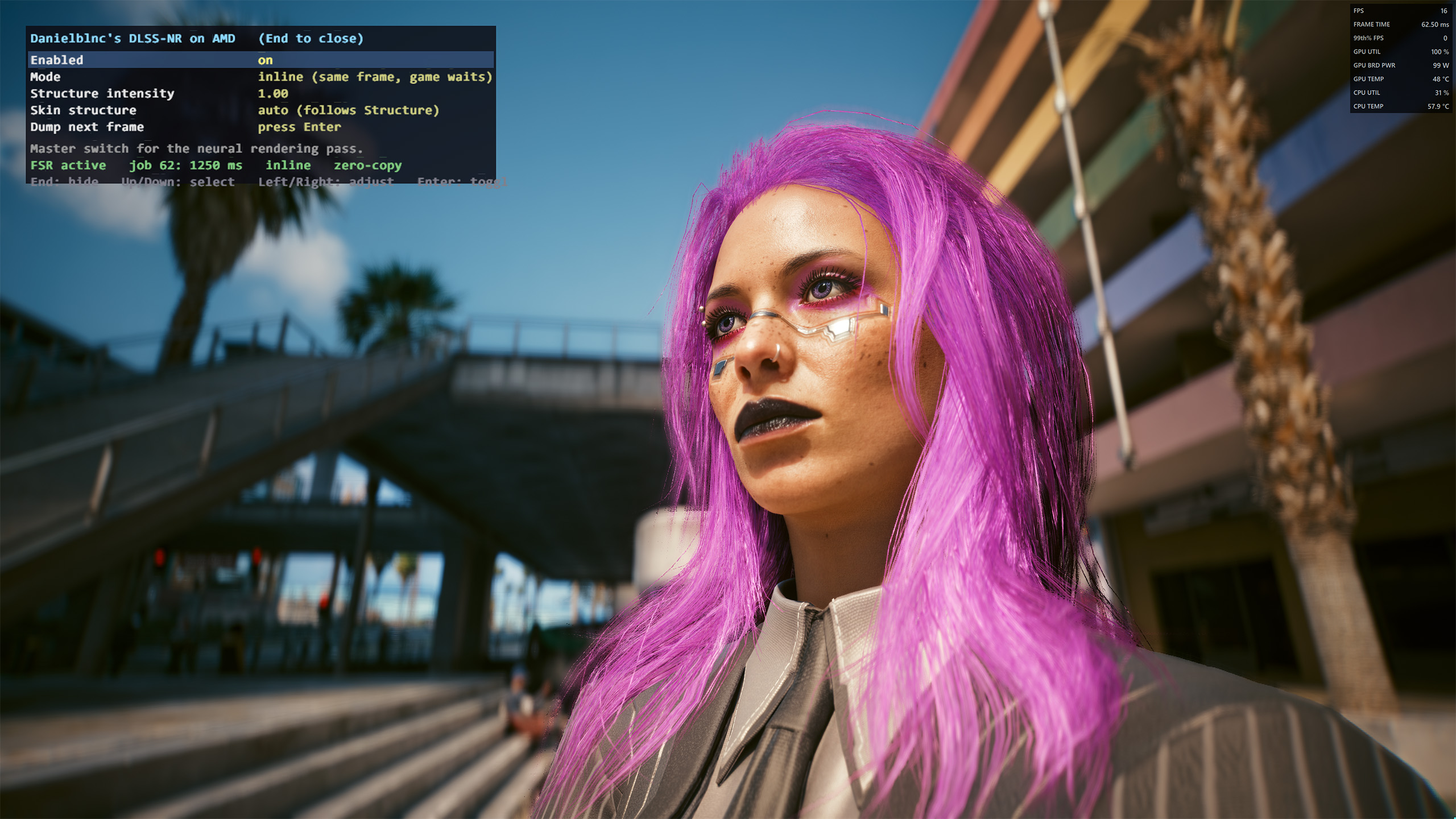
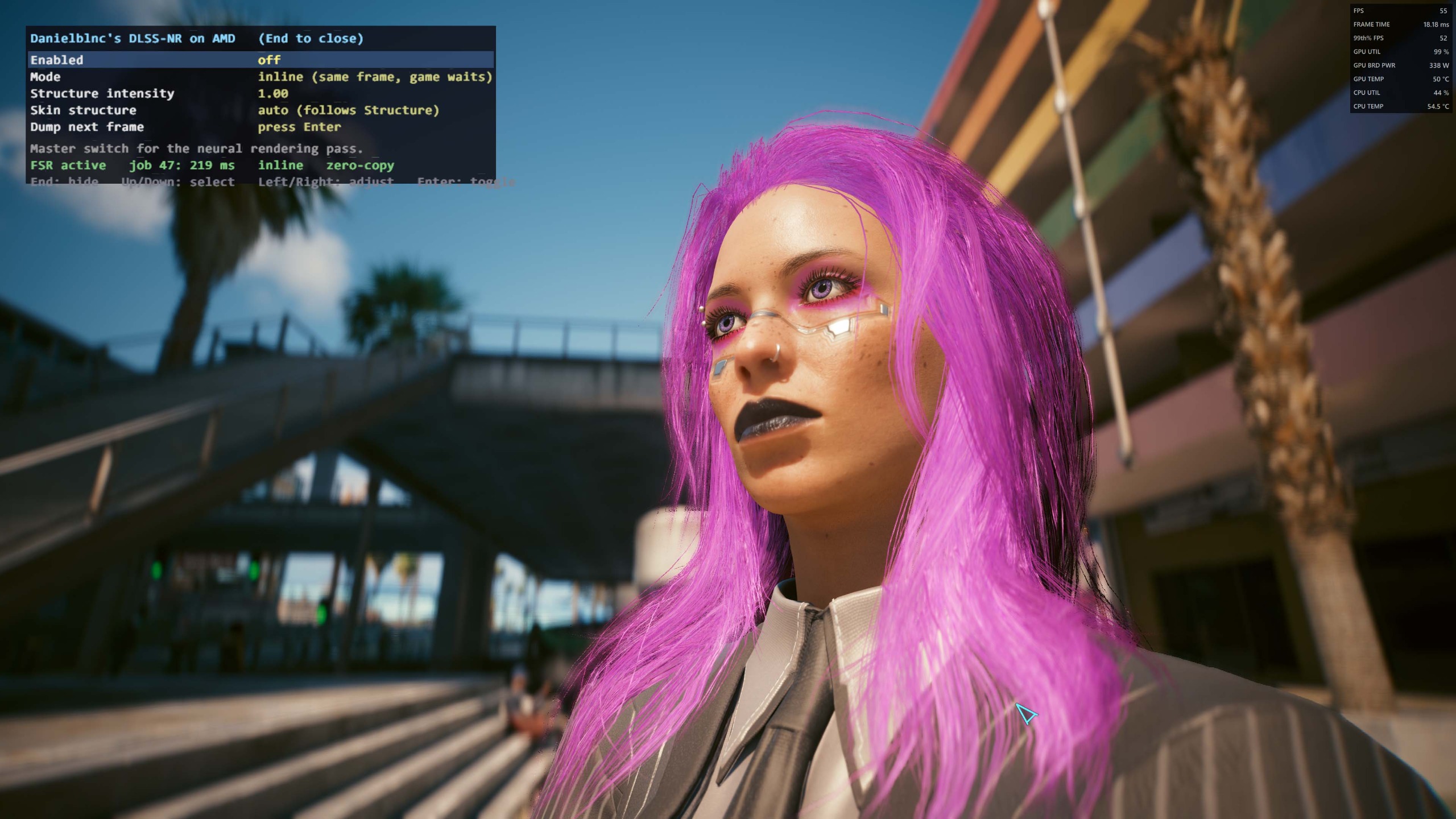


This is almost certainly the reason behind Nvidia originally running the feature on two GPUs for the original demos, and the fact that it can get it running on a single GPU is still impressive from a technical perspective, but having a coprocessor handling the load should give you the best of both worlds.
Though there are obvious caveats to this.
The first being that it's expensive enough to buy one graphics card right now. You look at this mod and the fact it's been created and tested on a pair of RTX 5060 Ti cards and think that's kinda mid-range. They are the fifth-tier cards of Nvidia's RTX Blackwell stack. But those are two GPUs that now cost something around $800 apiece, so we're still talking about needing $1,600 worth of graphics silicon to get this working.
The other caveat is that we're running on with two monitors here as a necessity. Guibout notes in the Github readme file that, "The second monitor is a requirement, not a nicety - the neural output is displayed by the card that produced it. Headless works and is meaningfully slower."
The third caveat here is that this ReShade implementation is a final step process. It is handled after the final frame has been rendered and works with none of the depth and motion vector information the official Nvidia implementation runs with. That means the second-GPU is going to have to be more tightly integrated into the actual rendering process. Not quite as tightly bound as with SLI, perhaps, but it will surely still need to get involved before the final post-processing is done.
But I could potentially see this as a way to do something useful with your current-gen card when you next upgrade. And, on a purely mercenary level, it might be a smart thing for Nvidia to actually make as a feature as it would have the effect of locking someone into the GeForce ecosystem even more securely.
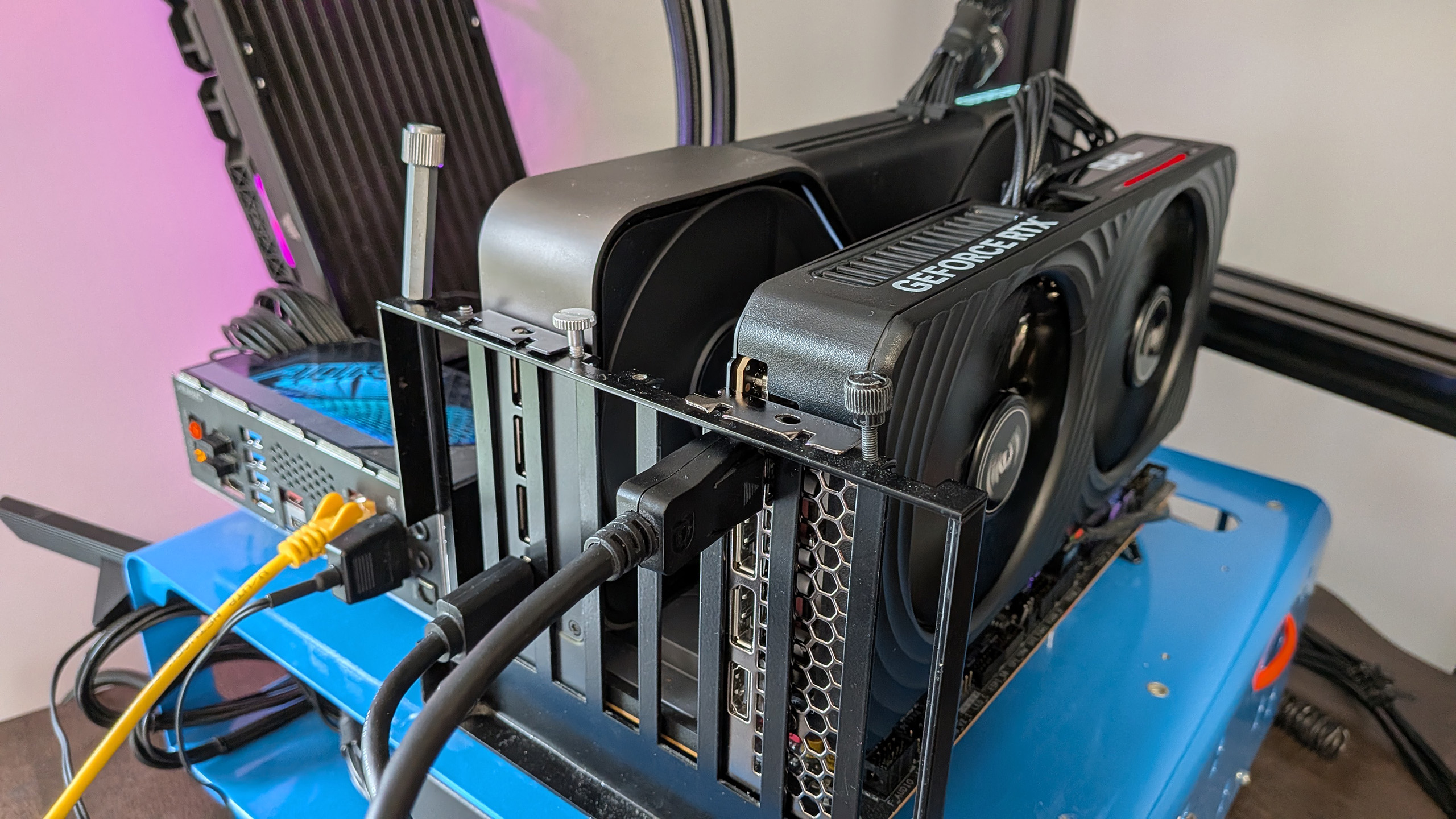
Though times have changed and SLI and CrossFire have died, and so motherboards are even less likely today to have multiple PCIe x16 sockets available to stick secondary GPUs into. Especially if you've got multiple NVMe SSDs taking up precious PCIe lanes.
I'm loving the rate of development happening outside of Nvidia now that the feature has fallen into the hands of the community at large. And regardless of how you feel about the technology, I would encourage you, if you have the hardware, to take a look at how even just the ReShade implementation looks, and how you can alter it. It gives a fascinating insight into the technology, into its limitations as well as its unwelcome excesses.
Though it's not always easy. I've spent the morning trying to get this ReShade add-on working with the test rig, because I was interested to see if it could be run asymmetrically, as I don't have a pair of RTX 5060 Ti 16 GB cards. Sadly, with an RTX 5080 and RTX 5060 Ti as the neural coprocessor, I could not get the add-on to arm when in Cyberpunk 2077. So, I've got more work to do to get this thing running.
Bare to spillere fra topp 10 er igjen i US Open i herresingel før kvartfinalene
US Open-turneringen i herresingel kan gå på én eller to måter: den mest forutsigbare veien, med en finale mellom de to øverste seedede spillerne (Alexander Zverev eller Carlos Alcaraz), eller med en finale der minst én spiller er utenfor topp 10. To kvartfinaler er bekreftet, den ene mellom den andre og den åttende seedede, Ben Shelton og Carlos Alcaraz.
Alle de andre spillerne som fortsatt er med i turneringen, ligger utenfor topp 10, bortsett fra Zverev (som spiller sin åttendedelsfinale mot Luciano Darderi i kveld, tidligst kl. 02:10 CEST, 01:10 BST tirsdag).
Resten av de toppseedede spillerne (fra den tredje til den tiende, bortsett fra Shelton som er nummer åtte: Felix Auger-Aliassime, Novak Djokovic, Flavio Cobolli, Alex de Miñaur, Daniil Medvedev, Taylor Fritz og Arthur Fritz) har røket ut i første, andre eller tredje runde. Og selvfølgelig uten Jannik Sinner, som trakk seg før turneringen på grunn av skader.